A useful picture
Imagine a very well-read assistant sitting at a desk. This person has read almost every
book and manual in the world. But they have one unusual problem: they remember nothing
about you, and nothing about yesterday.
They can only see the papers you place on the desk in front of them.
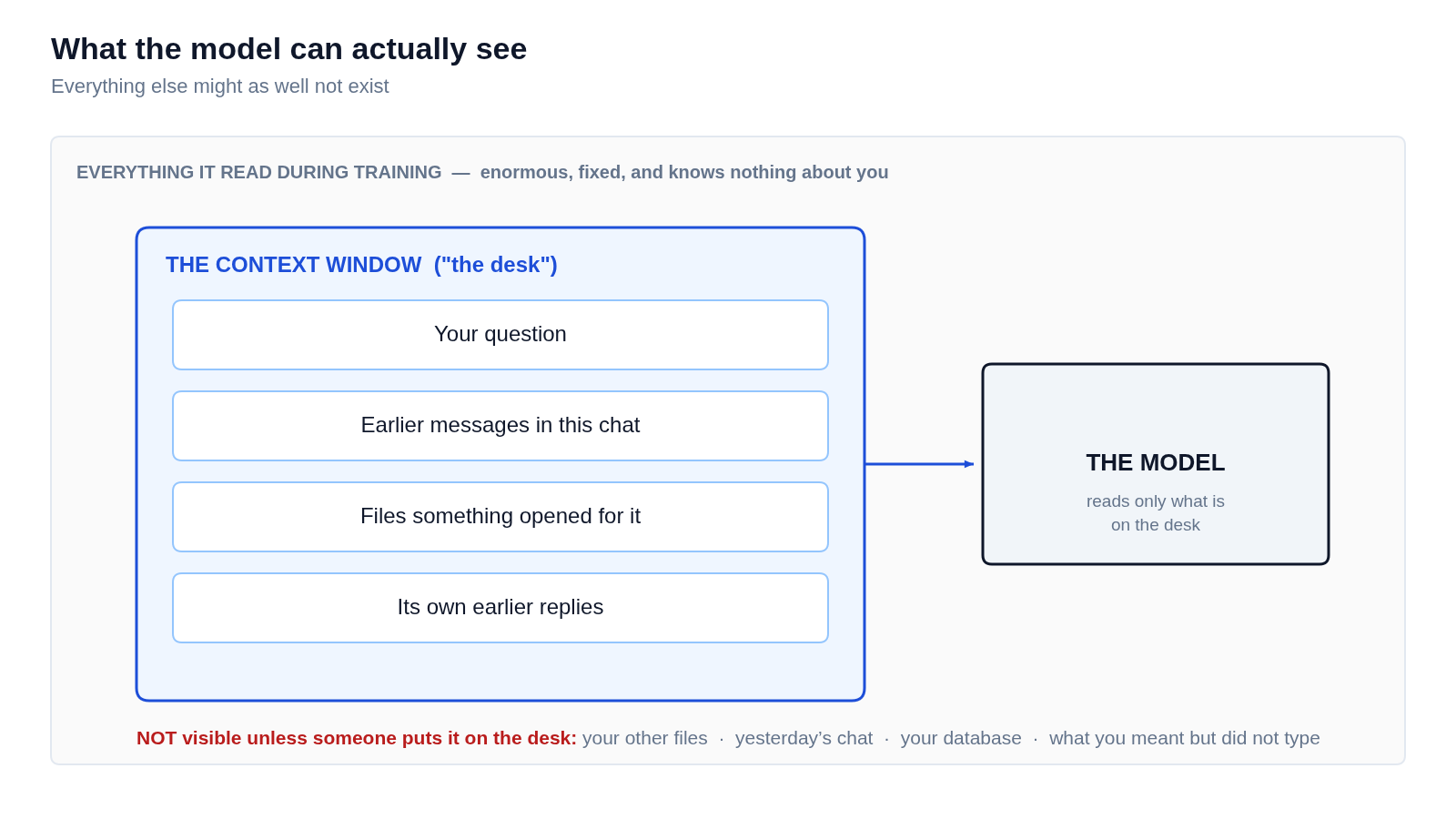
Those papers are the context window. The context window is all the text the model can
see at one moment: your question, the earlier messages in the conversation, and any files
someone has put in front of it.
What follows from this
The model does not know your project. It never “read your code” unless something actually
placed that code on the desk.
When you use an agent tool later in this course and it seems to understand your project,
something has quietly opened your files and put them in the context window. Nothing magic
happened. Somebody put papers on the desk.
This explains two problems you will meet constantly.
Too little on the desk. You ask about a function in your project without showing it the
function. The model still answers, because it always answers. It answers about a function
it has imagined.
Too much on the desk. The window has a limit. If you put four hundred pages in front of
a person and ask about one line on page two hundred, they will do worse than if you had
handed them one page. Models have the same weakness. Things in the middle get missed.
So the skill is not “give it everything”. The skill is “give it the right things”. That
skill has a name, context engineering, and Module 6 is entirely about it.
Try this before the next lesson
- In a fresh chat, ask: “What did I ask you two days ago?” Notice the answer. Now you know
what an empty desk looks like. - Paste a page of text, then ask a question about one sentence in the middle of it. Then
start a fresh chat, paste only that sentence, and ask the same question. Compare. - Write down, in one line, what you think is currently in the context window of the chat
you are using.