Start with the paper from Module 1
Take out the two sentences you wrote at the end of Lesson 1.7, describing something you
want to build. Keep them next to you for this whole module.
A short story
You tell someone: “Get me something to eat.”
They come back with a plate of poha. You wanted something sweet. They were not wrong. You
did not say.
Now imagine they cannot ask you anything. They must decide alone, immediately, and they
must look confident about it. That is the model.
The hidden decisions
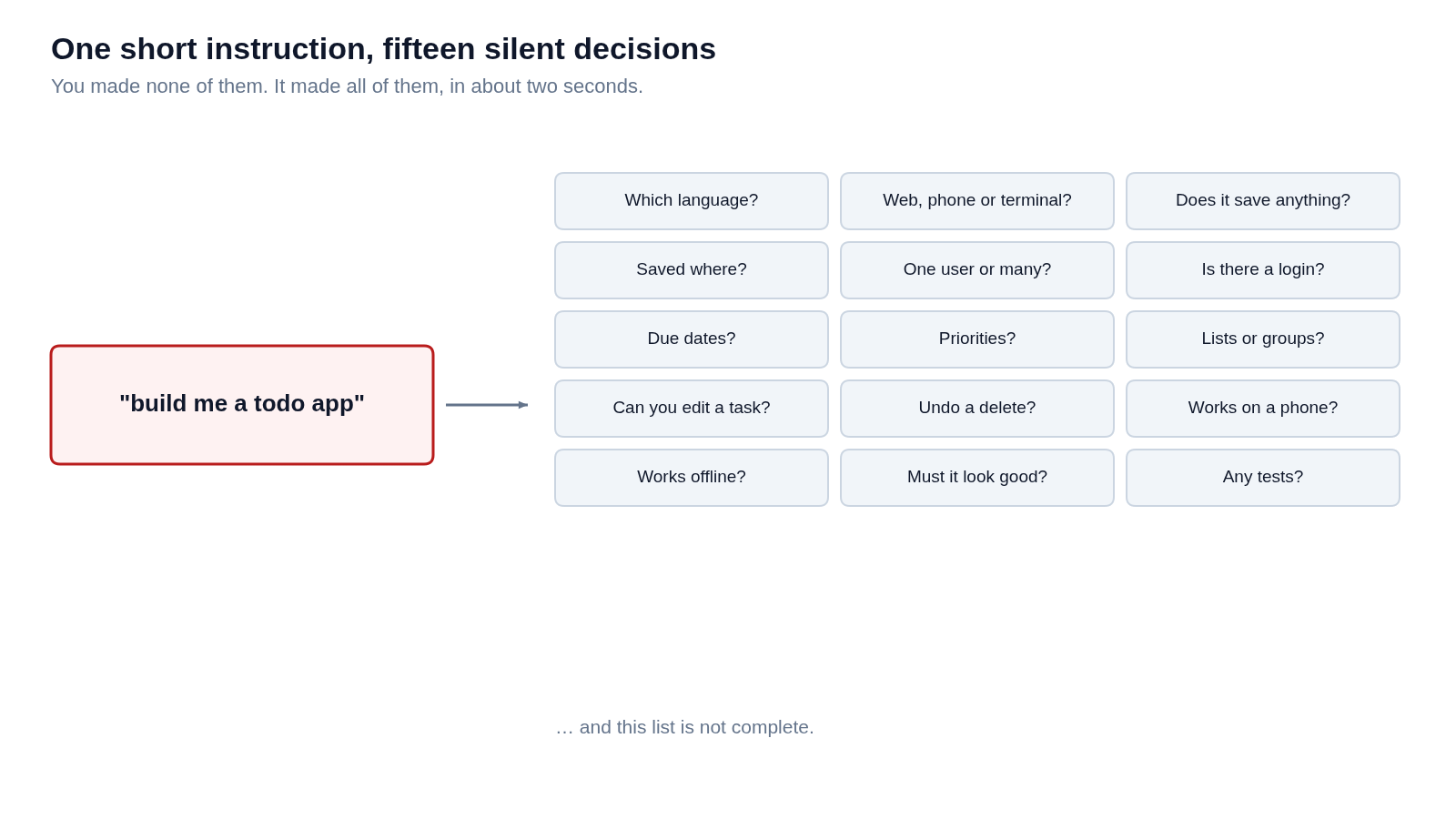
“Build me a todo app” sounds like one instruction. Watch how many separate decisions are
buried inside it:
- Which programming language?
- Website, phone app, or a program that runs in the terminal?
- Does it save the tasks anywhere, or do they vanish when you close it?
- Saved where? A file? A database? Which database?
- Do multiple people use it, or only you?
- If multiple people, is there a login?
- Can a task have a due date?
- Can a task be marked important?
- Can tasks be grouped into lists?
- Can a task be edited after it is created, or only deleted?
- What happens if you delete a task by mistake?
- Does it work on a phone screen?
- Should it work when the internet is off?
- Does it need to look good, or just work?
- Are there tests?
Fifteen decisions, and that list is not complete.
You made none of them. The model made all fifteen. It made them in about two seconds, it
did not tell you it was deciding anything, and it did not ask you a single question.
The rule to remember
Every choice you do not make, the model makes for you, silently.
Some newer tools do ask a question or two before starting. That helps. It does not change
the rule, because they still cannot ask about the ninety percent of choices you have not
thought about yet.
Why this feels unfair at first
Here is the uncomfortable part. When the model guesses wrong, it feels like the model
failed. It did not. It answered the question you asked. The question was just much smaller
than the question in your head.
The gap between those two questions is where all your effort should go.
Try this before the next lesson
- Take your two sentences. List every decision hidden inside them. Aim for ten.
- Ask a model to build the thing in your two sentences. Do not add anything. Count how
many of your ten decisions it got the way you wanted. - Ask a friend to list the hidden decisions in your two sentences. Did they find ones you
missed?