The unit
Models do not read letters or words. They read tokens. A token is a chunk of text,
usually a short word or a piece of a longer word. A rough guide: 1,000 tokens is about
750 English words.
Everything is counted in tokens: what you send in, and what comes back out.
Two things you pay for
Input tokens are everything in the context window: your question, the whole conversation
so far, and every file that was loaded.
Output tokens are what the model writes back.
Output usually costs more per token than input, but input is usually much larger. In a long
coding session, most of your cost is input, being sent again and again.
The part that surprises people
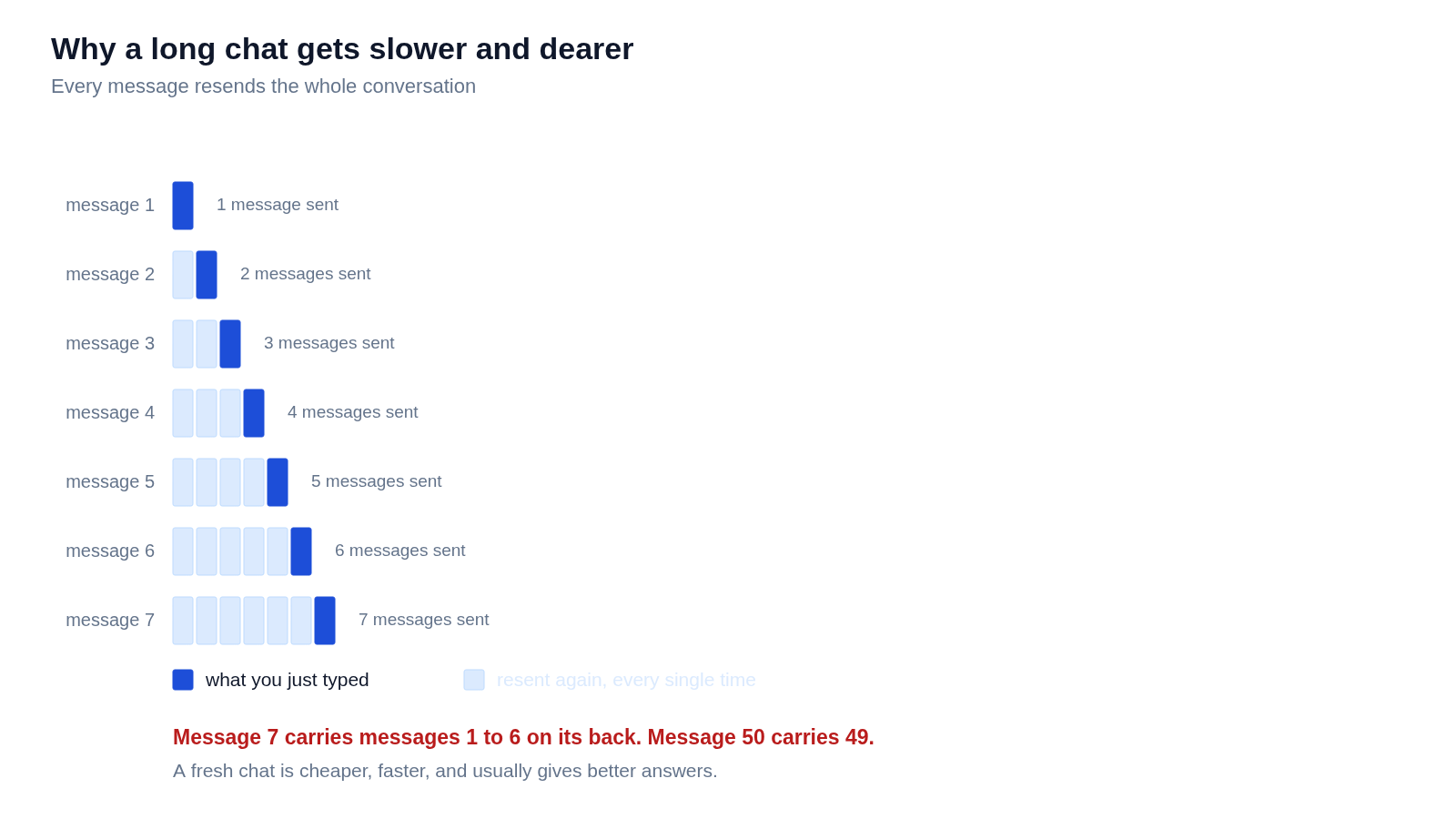
Every time you send a message in a long conversation, the whole conversation goes with it.
Message one is cheap. Message fifty carries messages one to forty-nine on its back.
This is why a long session gets slower and more expensive as it goes, even if your questions
stay short.
It is also why “just give the AI my whole project” is a bad instinct on three counts at
once. It costs more, it runs slower, and it gives worse answers, because of the
too-much-on-the-desk problem from Lesson 1.2.
Most tools reduce the cost by re-using parts of a conversation they have already processed.
This is called caching. It helps a lot with money and speed. It does not help with
quality, because the model still has to read all of it.
A practical habit
Start a fresh conversation when you switch to a different task. It is cheaper, it is faster,
and the answers are better because the desk is clear.
Module 7 comes back to this and treats model choice as a real engineering decision, the same
way you would choose between an expensive fast service and a cheap slow one.
Try this before the next lesson
- Find the token counter or usage page in the tool you use. Look at one real conversation.
- Ask the same question in a fresh chat and at the end of a long chat. Time both.
- Guess how many tokens this lesson is. Then paste it into a token counter and check.